 PlayJar


Sliding Puzzle
Free to Play · No Download · Updated
A free sliding puzzle in your browser. Play the 8 puzzle, the 15 puzzle or big 5×5 and 6×6 boards with numbers or pictures, hints and a daily puzzle.
Controls
- Click / Tap a Tile
- Slide it into the gap, or slide the whole line up to the gap
- Drag / Swipe
- Push a tile into the gap
- Arrow Keys / WASD
- Move the tile next to the gap into it
- H
- Show a hint
- P
- Peek at the numbers or the picture
- N
- New shuffle
- M
- Mute
- Esc
- Back to the menu
A Sliding Puzzle With Chunky Tiles
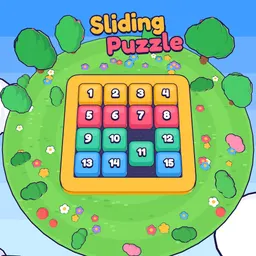
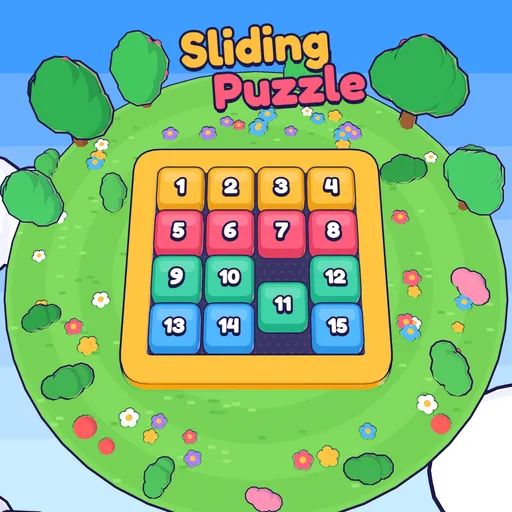
This is the slide puzzle you might remember from a party bag, rebuilt with big toon tiles on a tray on a little floating island. Tiles slide with a springy bounce, the gap shows up as a dark hole in the tray, and when you put the last tile in place the missing piece drops in and the board throws confetti.
Play the 8 puzzle on a 3×3 board, the classic 15 puzzle on a 4×4 board, or step up to 5×5 and 6×6 when you want a long one. Each board size keeps its own best time and fewest moves.
There are two tile styles. Number tiles are coloured by row, so you can see which rows are finished at a glance. Picture tiles show one of four original pictures: a sunny farm, an ocean full of fish, a rocket trip through space and hot air balloons at sunset. You rebuild the picture instead of counting.
How to Play
- Pick a size and a style. Choose 3×3, 4×4, 5×5 or 6×6, then Numbers or Picture. In picture mode, use the arrows to pick a picture.
- Press Play. The tiles hop into a random shuffle and the last tile pops off the board to leave the gap.
- Slide tiles into the gap. Tap a tile next to the gap to move it. Tap a tile further along the same row or column and the whole line slides over at once.
- Drag, swipe or use the keys. Drag a tile toward the gap, or swipe anywhere on the screen. On a keyboard, the arrow keys or WASD push the tile next to the gap into it.
- Finish the board. Numbers go 1, 2, 3 from left to right, row by row, with the gap in the bottom right corner. Pictures go back together the way they started.
Stuck? Press Hint for an arrow on a good next move. Press the Picture or Numbers button to peek at the other face of the tiles. In number mode it shows the picture, and in picture mode it puts small numbers on the picture tiles, which makes the order much easier to follow.
How to Solve a Sliding Puzzle
You don’t need to plan the whole solution. The method most people use breaks the board into small jobs, and it works on every size.
- Solve the top row. Bring tile 1 to the top left corner, then 2 next to it, and so on along the row. Once the row is done, never touch it again.
- Save the last two tiles of the row for a trick. The last two tiles can’t go in one at a time without knocking the others out. On a 4×4 board, put tile 3 in the top right corner (where 4 goes) and tile 4 directly under it. Then bring the gap to the spot where 3 belongs and slide 3 across and 4 up. Both drop into place together.
- Repeat row by row. Work down the board the same way until only two rows are left. The game cheers each finished row.
- Finish the last two rows column by column. Now go left to right. For each column, put the tile that belongs on top in the bottom spot, with the tile that belongs below it just to its right. Bring the gap to the top spot and slide the first tile up and the second across. It’s the same trick as before, turned on its side.
- Turn the last square. The final 2×2 corner just needs the three tiles rotated round the gap until they click into order.
In number mode each row has its own colour, so following this method is easy to see: yellow first, then red, then green and so on.
Tips
- Move the gap, not the tile. Think about where the gap needs to be for the tile you want to move, then walk the gap there along a path that doesn’t touch your finished tiles.
- Line slides save time. Tapping the far tile in a row moves several tiles at once, which is quicker than tapping each one.
- Don’t chase the fewest moves on your first go. Learn the method, then work on speed, then on moves.
- On the 3×3 board the hint shows a shortest solution. Following it a few times is a good way to learn how short a solve can be.
- For the picture puzzles, find the corners and edges first, just like a jigsaw. The sky and ground make the top and bottom rows easy to spot.
- If you get lost, press New for a fresh shuffle. There’s no penalty.
A Short History of the 15 Puzzle
The 15 puzzle was made in the 1870s in upstate New York, and it’s usually credited to Noyes Chapman, a postmaster in Canastota. By early 1880 it was a craze across the United States and Europe, sold as the Gem Puzzle and played in offices, trains and newspapers.
Part of the fuss came from a version where tiles 14 and 15 started swapped. People spent hours on it, but it can’t be solved. In 1879 the mathematicians William Johnson and William Story proved that only half of all layouts can be reached, and a single swapped pair is always in the other half. Puzzle writer Sam Loyd later claimed he had invented the game and offered a big prize for solving the swapped version, knowing no one could.
Today the sliding puzzle is a favourite example in computer science. The 8 puzzle has 181,440 solvable layouts and the 15 puzzle has more than 10 trillion. Programs that find the shortest solution use a search called IDA*, and that’s what powers the hint on the 3×3 board here.
Questions Players Ask
Is This Sliding Puzzle Free?
Yes. It's free to play in your browser on a phone, tablet or computer. There's nothing to download and no account to make.
What Is the 15 Puzzle?
The 15 puzzle is the classic slide puzzle with 15 numbered tiles in a 4×4 frame and one empty space. You slide tiles into the space until the numbers run 1 to 15 in order. Pick 4×4 in the menu to play it.
What Is the 8 Puzzle?
The 8 puzzle is the small 3×3 version, with 8 tiles and one gap. It's the best place to start, and most shuffles take only 20 to 30 moves when you play well.
Is Every Shuffle Solvable?
Yes. Only half of all possible layouts of a sliding puzzle can be solved, so the game checks every shuffle and only deals ones that can be finished.
How Does the Hint Work?
Hint points an arrow at a good next move. On the 3×3 board it follows a shortest solution. On bigger boards it follows the rows first method, and when you're close to the end it switches to a shortest solution too. Follow the hints and the puzzle always gets solved.
How Are Moves Counted?
Every tile that slides counts as one move. If you slide a line of three tiles at once, that's three moves. The timer starts on your first move, not when the board appears.
What Is the Daily Puzzle?
Every day there's one new 4×4 picture puzzle, and everyone gets the same shuffle. Your time for the day is saved and shown on the Daily button.
What Is the Hardest 15 Puzzle Position?
Any solvable 15 puzzle can be finished in 80 single-tile moves or fewer, and a few positions need all 80. For the 8 puzzle the worst case is 31 moves.
Are My Best Times Saved?
Yes. Your best time and fewest moves for each board size are saved in your browser on this device, along with your daily results.
More Free Games to Try
- Fruit Merge: Play Fruit Merge free online. Drop cute fruit into a 3D bowl, merge two of the same into bigger fruit and spin the bowl to grow a watermelon.
- Flag Reveal: A free flag quiz where tiles flip away to reveal each flag. Guess the flag early for more points, keep your streak and master all 197 countries.
- Think Twice!: Think Twice! is a free tricky puzzle game you play online. 100 brain teasers and trick questions where the obvious answer is wrong. Can you outsmart them?
- Charades: A free charades generator with 600+ charades ideas in 13 categories, plus a team game with a timer and scores and a tilt-to-play forehead mode.
- Falling Sand: A free falling sand game in your browser. Pour sand, water, lava, fire, acid and 12 more elements, and watch them flow, burn, melt, grow and explode.
- Liar's Dice: Play Liar's Dice free online against 2 to 5 computer players. Bid, bluff and call Liar with real 3D dice. Wild ones, Spot On and odds help included.